
AI and Employment: What Anthropic Says (and What They're Not Telling You)

Anthropic has released the most detailed map to date of which jobs AI is replacing. And the most interesting data point isn't in the headlines.
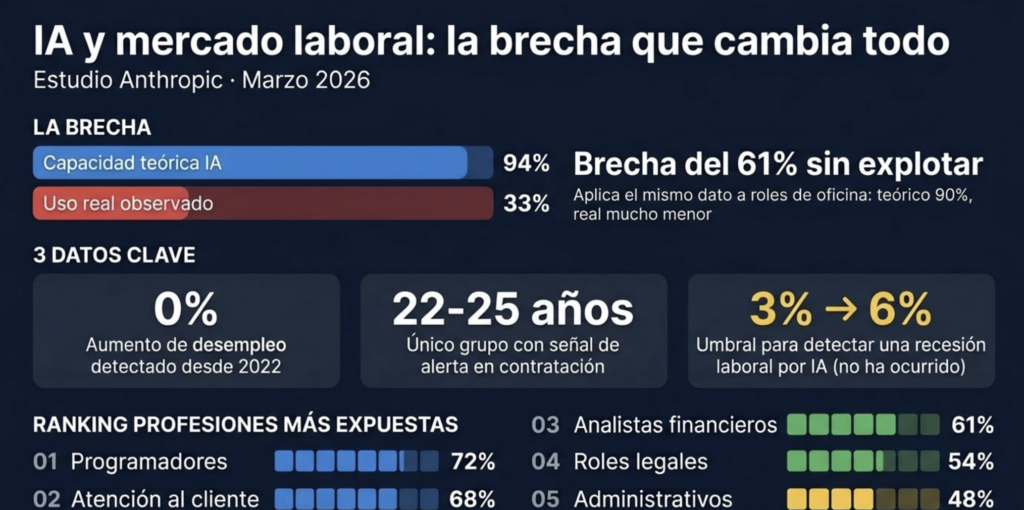
It's not that programmers are the most exposed (they are, with 94% of their tasks technically automatable). The relevant finding is that Claude actually only covers 33% of those tasks in real professional use.
That is the gap. And that gap changes everything.
The Difference Between What AI Can Do and What It Does
The study introduces a new concept: "observed exposure." Unlike previous theoretical analyses that asked "could an AI do this?", Anthropic measures which tasks are actually being automated in professional work environments, using real usage data from Claude.
The result is revealing. In office and administrative roles, the theoretical capability of AI is close to 90%. Real-world adoption is far lower. The same pattern repeats in finance, legal, and management.
Why the gap? The researchers point to concrete barriers: integration with existing software, legal requirements for human verification, slow organizational adoption processes, and regulatory frameworks that demand human oversight in critical decisions.
The EU AI Act is not a bureaucratic obstacle. It is part of why that gap exists and must exist.
The Unemployment Data No One is Reporting Correctly
Here's what the apocalyptic headlines don't say: there is no evidence of increased unemployment in the sectors most exposed to AI. The researchers compared unemployment rates between highly exposed and non-exposed workers since late 2022, and the difference is statistically negligible.
For there to be an impact comparable to the Great Recession of 2007-2009, unemployment in the most exposed quartile would have to rise from 3% to 6%. This has not happened.
There is one early warning signal: the hiring rate for young workers (22-25 years old) in exposed sectors does show a slowdown. Suggestive, not conclusive.
Which Professions Are Really in the Crosshairs
According to Anthropic's analysis, the jobs with the highest real observed exposure are:
- Programmers and software developers
- Customer service representatives
- Financial analysts
- Entry-level legal and administrative roles
The demographic pattern is also relevant: the most exposed workers tend to be more educated, better paid, and, notably, have a higher female presence.
What This Means for Companies
At Montevive, we have been working for months with companies managing AI adoption without exposing themselves to compliance risks. This study confirms something we were already seeing in the field: real AI adoption is much slower than headlines suggest, precisely because mature organizations manage that process with judgment.
The real risk is not with companies that adopt AI with governance. It's in shadow AI: employees using unaudited tools, without usage policies, without data control. That does generate legal, data, and reputational exposure.
What to Do Now
AI is not going to replace your team tomorrow. But it is redefining which tasks have value and which do not. The time to design your AI usage policy is not when the problem has already occurred.
Start with a diagnosis: do you know which AI tools your employees are already using?