
Secure AI in 2026: 5 Trends Every Entrepreneur Should Know and How to Prepare

72% of security managers say the risk has never been as high as it is now, according to Vanta’s State of Trust 2025. And they are right.
During 2025, while companies celebrated how ChatGPT saved them time writing emails, attackers automated hyper-personalized phishing campaigns that deceived even experienced executives. The average cost of a data breach in the United States reached $10.22 million, an all-time high according to IBM.
But here’s the important thing: 2026 will not be more of the same. It will be the year companies move from playing with AI to governing it. And those who don’t will pay a very high price.
At Montevive.AI, we have been helping companies implement AI securely for over a year. What we see every day confirms something: most organizations are adopting AI tools much faster than they can secure them. And that is creating a ticking time bomb.
In this article, I will tell you about the 5 trends that will define secure AI in 2026, with concrete examples and actions you can start implementing today.
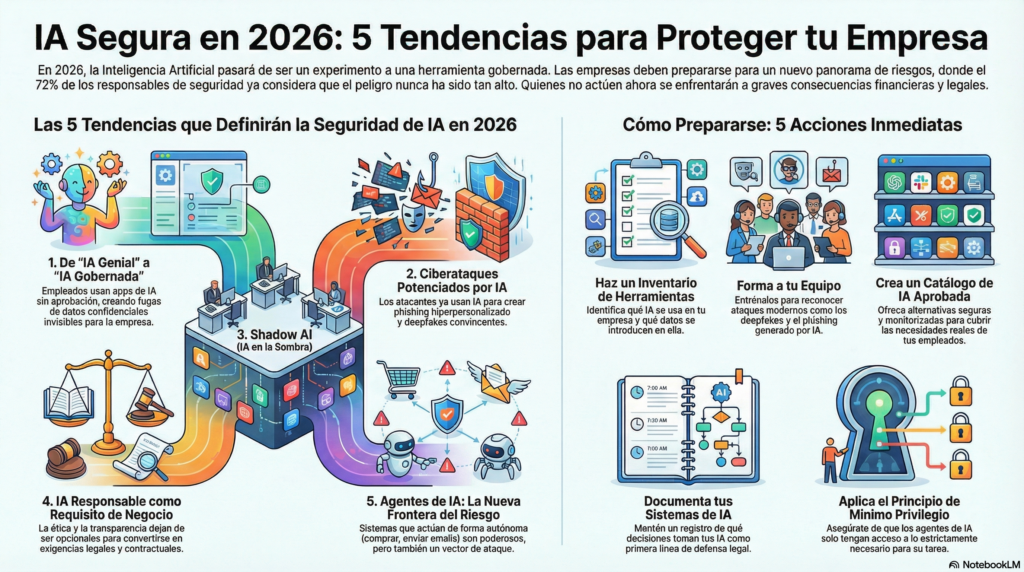
1. From “Great AI” to “Governed AI”: The End of Improvisation
What’s happening
During 2024 and 2025, many companies allowed their employees to experiment freely with AI tools. “Try ChatGPT for this,” “use Copilot for that.” The problem is that no one kept track of what data was entered, what models were used, or who had access to what.
The numbers are revealing: only 44% of companies have a defined AI usage policy, according to Vanta. And barely 45% conduct regular risk assessments related to AI.
Why this matters to your business
Imagine an accounting employee pasting an Excel sheet with customer data into ChatGPT to help them analyze it. Where does that data go? Who can access it later? Does this comply with the GDPR?
The honest answer is: no one knows.
In 2026, according to IBM, boards of directors are going to start demanding specific AI risk reports. Not because they want to, but because regulators and customers are going to demand it.
What you can do now
Start with something simple: an inventory. What AI tools does your team use? What data goes into each one? You don’t need an expensive consultant for this. A spreadsheet and two hours of conversations with your departments is enough to get started.
Then, define three basic things: which tools are approved, what type of data can be used in each one, and who authorizes new tools. This is not bureaucracy; it is the minimum viable to avoid unpleasant surprises.
2. AI-Powered Cyberattacks: The Race You Can’t Ignore
What’s happening
Attackers have the advantage. While you decide whether to adopt AI, they are already using it to:
- Hyper-personalized phishing: Emails that appear to be written by your boss, with details that only he would know. IBM X-Force reports that these attacks have multiplied in 2025.
- Automated reconnaissance: Bots that scan LinkedIn, corporate websites, and social networks to build detailed employee profiles and find the best way to attack.
- Real-time deepfakes: There are already cases of video calls where the attacker impersonates an executive to authorize transfers. Harvard Business Review calls it “the CEO doppelgänger” and considers it one of the main threats for 2026.
Why this matters to your business
56% of companies experience threat activity at least once a week, according to Vanta. And half have noticed an increase in phishing, malware, and identity fraud generated by AI.
But here’s what’s interesting: the same AI that attackers use can defend you. 95% of companies that use AI in security report improvements in the effectiveness of their teams. The trick is to use it before they use it on you.
What you can do now
Three concrete actions:
- Train your team to recognize AI attacks: The typical “don’t click on suspicious links” course is not enough. They need to see real examples of deepfakes, AI-generated phishing, and modern social engineering attacks.
- Implement identity verification in critical operations: If someone asks for an urgent transfer by video call, have a verification protocol that does not depend on the channel. A pre-agreed keyword, a confirmation call to a known number.
- Consider AI detection tools: There are solutions that detect AI-generated content, deepfakes, and automated attack patterns. They are not perfect, but they add a valuable layer of protection.
3. Shadow AI: The Ghost That Is Already in Your Company
What’s happening
“Shadow AI” is the new “shadow IT.” These are all those AI tools that your employees use without IT knowing: the Chrome extension that summarizes documents, the Telegram bot that translates, the app that transcribes meetings.
IBM predicts that in 2026 we will see serious incidents where confidential information is leaked through uncontrolled “shadow AI” systems. And this is not paranoia: 13% of companies already reported a security incident related to AI in 2025, and 97% of them acknowledged that they did not have adequate access controls.
An example that explains everything
Imagine this scenario: your marketing manager discovers a free AI tool that generates spectacular images. They use it for a campaign with photos of real customers. Those photos are now on the servers of an AI company somewhere in the world, probably being used to train models.
The result? A legal risk, a privacy problem, and a reputation crisis waiting to happen.
What you can do now
The traditional “prohibit everything” approach does not work. If you block the tools, employees will find ways to use them anyway, probably on their personal mobiles.
The alternative is to create a “catalog of approved tools” that covers real needs. Does your team need to summarize documents? Offer them a secure tool that does it. Do they need to generate images? Find an option that respects privacy.
In addition, implement basic monitoring: what AI tools are being used on the corporate network, what data is leaving to external services. Not to spy, but to detect risks before they explode.
4. Responsible AI: From “Nice to Have” to Business Requirement
What’s happening
Ethics and responsibility in AI are ceasing to be conference topics and are becoming contractual requirements. According to PwC, in 2026 we will see the first legal cases where executives are personally responsible for the actions of poorly governed AI systems.
Gartner predicts that 40% of business applications will include specific AI agents in 2026, but only 6% of organizations have an advanced AI security strategy. That gap is a problem waiting to become litigation.
Why this matters to your business
It’s no longer just reputation. It’s money and legal responsibility.
If your company uses AI for decisions that affect customers (prices, credits, hiring), and that AI has biases or errors, the responsibility is yours. And “the algorithm decided it” is not an acceptable defense.
In addition, more and more large clients are including “responsible AI” clauses in their contracts. If you can’t prove that you comply, you lose the contract.
What you can do now
Three practical steps:
- Document your AI systems: What decisions they make, with what data they are trained, who supervises them. This documentation will be your first line of defense if something goes wrong.
- Implement human review in critical decisions: If your AI decides something that significantly affects a person (rejecting a credit, not hiring someone), make sure a human reviews the decision.
- Do bias audits: Periodically check if your AI systems are treating all groups fairly. There are automated tools that facilitate this.
5. AI Agents: The New Frontier (and the New Risk)
What’s happening
AI agents are the big novelty of 2025-2026. They are not simple chatbots that answer questions. They are systems that act: they read your emails, schedule meetings, make purchases, execute code.
Microsoft predicts that 2026 will be the year when agents move from demos to real use in companies. Google Cloud talks about “digital assembly lines” where agents execute complete workflows.
The problem is that an AI agent with access to your systems is basically an employee who never sleeps, never questions orders, and can act much faster than any human. That is powerful, but also dangerous.
The concrete risks
Harvard Business Review identifies several agent-specific attack vectors:
- Prompt injection: Tricking the agent into doing something it shouldn’t. As if someone convinced your assistant that their boss authorized them to transfer money.
- Privilege escalation: The agent gradually accesses more systems than it should.
- Misuse of tools: The agent uses its capabilities (sending emails, making purchases) in unforeseen ways.
Machine identities (agents, bots, APIs) already outnumber human identities by a ratio of 82 to 1 in typical companies. And most security systems are not designed to manage this.
What you can do now
If you already use or plan to use AI agents:
- Principle of least privilege: The agent should only have access to what is strictly necessary for its task. If it organizes meetings, it does not need access to financial data.
- Human supervision in critical actions: Before the agent executes something important (a purchase, a mass email), a human must approve.
- Continuous monitoring: Record what the agent does, when, and why. If it starts behaving strangely, you need to detect it quickly.
- Clear identity: Each agent must have its own identity, separate from human users. This way you can track exactly who did what.
The regulatory landscape: What’s coming
Nature recently published an editorial calling for 2026 to be the year of global cooperation in AI security. The message is clear: regulation is coming, and it’s coming strong.
In Europe, most of the rules of the AI Act will enter into force in August 2026. In the United States, although the federal government has slowed down initiatives, the states are actively legislating (82 AI laws approved in 2024 alone).
The important thing for companies: regulations are going to require transparency. You will have to explain how your AI systems work, prove that they are safe, and be responsible for the damages they cause.
Preparing now is cheaper than adapting later.
Conclusion: The Time to Act Is Now
2025 was the year of experimentation. 2026 will be the year of consequences.
Companies that arrive with their homework done (clear governance, inventory of tools, team training, basic monitoring) will navigate this new world without problems. Those that don’t will discover in the worst way that poorly managed AI is a liability, not an asset.
The good news is that you don’t need to be a large corporation with a million-dollar budget. Most of the measures I have described can be implemented with modest resources. What you need is decision and a plan.
Where to start? My recommendation: this week, do the inventory. Sit down with your department heads and ask what AI tools they are using. Just that will give you a vision that most of your competitors don’t have.
Do you want to delve deeper into how to protect your company? At Montevive.AI we help companies implement AI securely. Contact us for a free initial assessment.
References used
- TechCrunch – In 2026, AI will move from hype to pragmatism
- IBM – The trends that will shape AI and tech in 2026
- IBM – Cybersecurity trends: IBM’s predictions for 2026
- Nature – Let 2026 be the year the world comes together for AI safety
- Microsoft – What’s next in AI: 7 trends to watch in 2026
- Vanta – Top 6 AI security trends for 2026
- HBR/Palo Alto Networks – 6 Cybersecurity Predictions for the AI Economy in 2026
- PwC – 2026 AI business predictions
- Google Cloud – AI agent trends 2026 report