


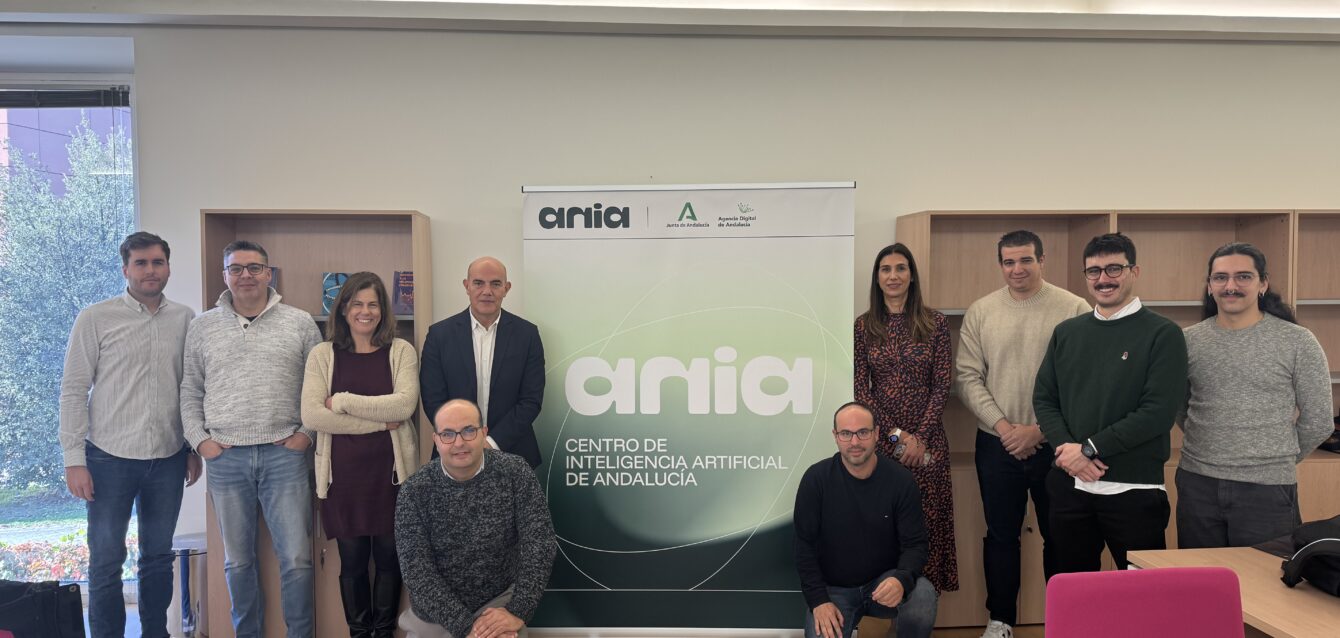
Yesterday, we had the opportunity to participate in an extraordinary session of the IBM Quantum and ADA ambassadors program—an experience that allowed us to immerse ourselves in the fascinating world of quantum computing and explore firsthand the latest innovations defining the future of this technology.
Special Thanks
Before diving into the technical details, we would like to express our sincere gratitude to Miguel Ángel and Álvaro from IBM, who led this workshop with exceptional dedication and expertise. Their ability to make such complex concepts accessible and their passion for quantum technology were truly inspiring.
We would also like to deeply thank ADA and the Chamber of Commerce for inviting us to participate in this initiative. These learning and networking opportunities are invaluable for staying at the technological forefront and being part of such a vibrant community of innovators.
The Latest News from IBM Quantum
IBM continues to lead the quantum revolution with impressive developments in recent months. During the session, we learned about the company’s most recent advances, including:
The Nighthawk processor and the roadmap to 2029
IBM has presented its Nighthawk quantum processor, marking a crucial step toward fault-tolerant quantum computing. The company has established an ambitious roadmap that promises quantum advantage by the end of 2026 and fault-tolerant quantum computing by 2029.
Advances in error correction
One of the greatest challenges in current quantum computing is error management. IBM has made significant progress in error mitigation and correction techniques, which are fundamental elements for making industrial-scale quantum computing viable.
Expansion of the quantum ecosystem
The IBM Quantum platform now features over 100 qubits in its fleet of quantum computers, offering unprecedented access to researchers and developers worldwide.
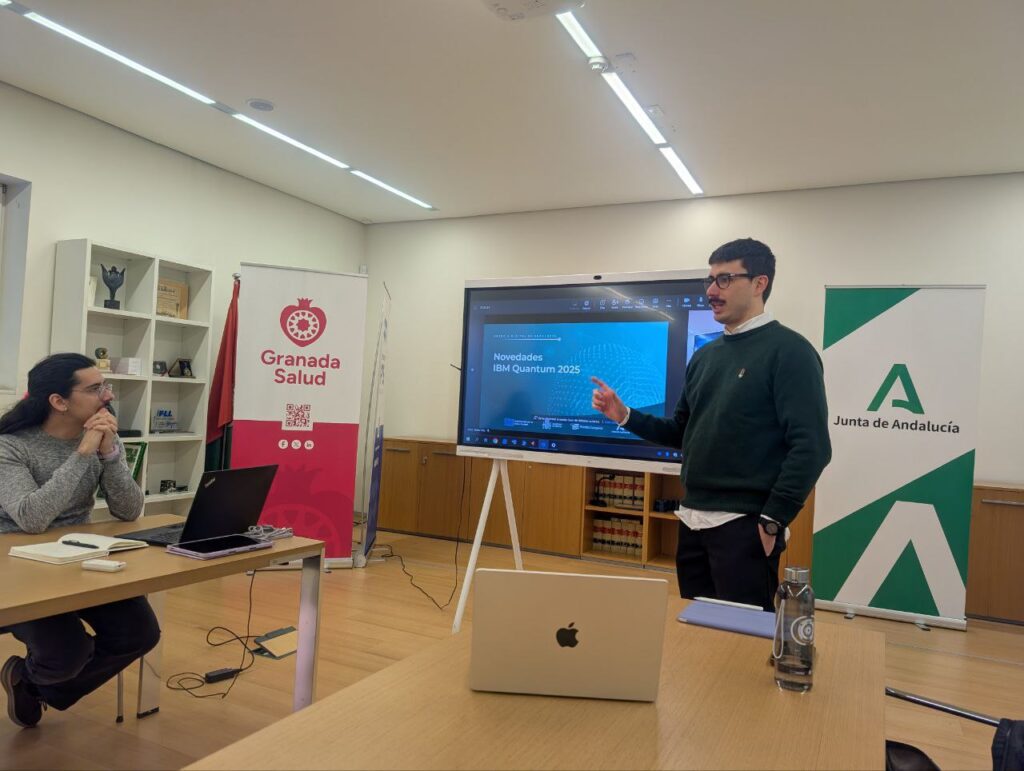
Our First Quantum Circuit with IBM Quantum Composer
The most exciting part of the day was the hands-on experience with IBM Quantum Composer, the graphical tool that allows for building quantum circuits through an intuitive drag-and-drop interface.
What is IBM Quantum Composer?
It is an online platform that democratizes access to quantum programming. Without requiring deep knowledge of quantum physics, it allows developers and researchers to create and run real quantum circuits on IBM quantum hardware.
Our hands-on experience
Under the expert guidance of Miguel Ángel and Álvaro, we built our first quantum circuit, experimenting with:
- Basic quantum gates: Hadamard, Pauli-X, CNOT
- Superposition and entanglement: The fundamental phenomena that power quantum computing
- Quantum measurement: How to extract useful information from quantum states
The experience was eye-opening. Seeing how complex theoretical concepts translate into simple visual operations helped us better understand the potential and peculiarities of this technology.
Promising Use Cases: The Revolution in Graph Optimization
During the session, we explored several real-world use cases where quantum computing is showing its true potential. However, one of the most fascinating and promising was graph optimization, especially applied to complex infrastructure problems.
Electrical distribution networks: The holy grail of optimization
The case that impacted us the most was the application of quantum algorithms to the optimization of electrical distribution networks. As we well know, this is a classic NP-complete problem that has challenged traditional computational systems for decades.
Why is it so complex?
- Exponential scalability: The number of possible configurations grows exponentially with the size of the network
- Multiple variables: Fluctuating demand, line capacity, generation costs, and safety constraints
- Real-time optimization: Conditions change constantly, requiring continuous recalculations
Quantum advantage in action
Quantum algorithms, such as the Quantum Approximate Optimization Algorithm (QAOA), can explore multiple solutions simultaneously thanks to quantum superposition. This means that problems that would take years to solve with classical methods could be solved in minutes or hours.
Real Impact
- Reduction in energy costs: Optimization of distribution routes can reduce losses by up to 15%
- Greater grid stability: Better management of demand peaks and failures
- Integration of renewables: Dynamic optimization for intermittent energy sources
Other graph optimization cases we explored:
- Logistics and transport: Real-time delivery route optimization
- Telecommunications networks: Optimal data traffic management
- Supply chains: Inventory and distribution optimization
- Urban planning: Optimization of traffic and public transport
Current Possibilities of Quantum Computing
Beyond graph optimization, quantum computing is already generating tangible results in several fields:
Molecular and Chemical Simulation
- Drug discovery: Simulation of complex molecular interactions
- Materials development: Design of new materials with specific properties
- Catalysis: Optimization of industrial chemical processes
Quantum Machine Learning
The intersection between AI and quantum computing promises exponentially more efficient algorithms for certain machine learning problems.
Cryptography and security
While it poses challenges for current cryptography, it also opens new possibilities in ultra-secure communications through quantum key distribution.
Current Limitations and Challenges
However, quantum computing still faces significant obstacles:
Quantum decoherence
Qubits are extremely fragile. Any interference from the environment can destroy quantum information in microseconds, limiting the complexity of possible calculations.
High error rates
Current quantum computers have much higher error rates than classical systems. Every quantum operation introduces errors that accumulate quickly.
Scalability
Although IBM has reached 100+ qubits, building systems with thousands or millions of coherent qubits remains a monumental challenge.
Specific algorithms
Quantum computing is not universally superior. Only certain specific problems can benefit from quantum acceleration.
Reflections from Montevive
As a company specializing in local and private AI, this experience has made us reflect on the future implications of quantum computing for our sector:
Quantum-AI convergence
The combination of quantum algorithms with classical AI could revolutionize local data processing, maintaining privacy while accessing unprecedented computational capabilities.
Business optimization
NP-complete problems are omnipresent in the business world: from resource optimization to logistics planning. Quantum computing could transform how companies approach these challenges.
Quantum security
The quantum threat to current cryptography reinforces the importance of our focus on local and private solutions, anticipating a future where quantum security will be essential.
Technological democratization
Tools like IBM Quantum Composer demonstrate how complex technologies can become accessible, something that resonates deeply with our mission to make AI accessible to all companies.
Looking Toward the Future
The IBM Quantum and ADA ambassadors day confirmed that we are at a historic moment. Quantum computing is transitioning from pure research to practical applications, although there is still a way to go.
For companies like ours, it is crucial to stay informed about these developments. Although practical quantum computing is still a few years away, organizations that understand its possibilities and limitations will be better positioned to take advantage of this technological revolution.
Quantum computing will not replace classical computing, but rather complement it, solving specific problems that are beyond the reach of traditional systems. And at Montevive, we will continue to explore how these emerging technologies can be integrated with our local and private AI solutions.
Once again, thanks to Miguel Ángel, Álvaro, and the entire IBM team, as well as ADA and the Chamber of Commerce, for making this enriching experience possible, which will undoubtedly mark our path toward innovation.