
JuntaGPT vs ChatGPT: Why the Junta de Andalucía Created Its Own AI
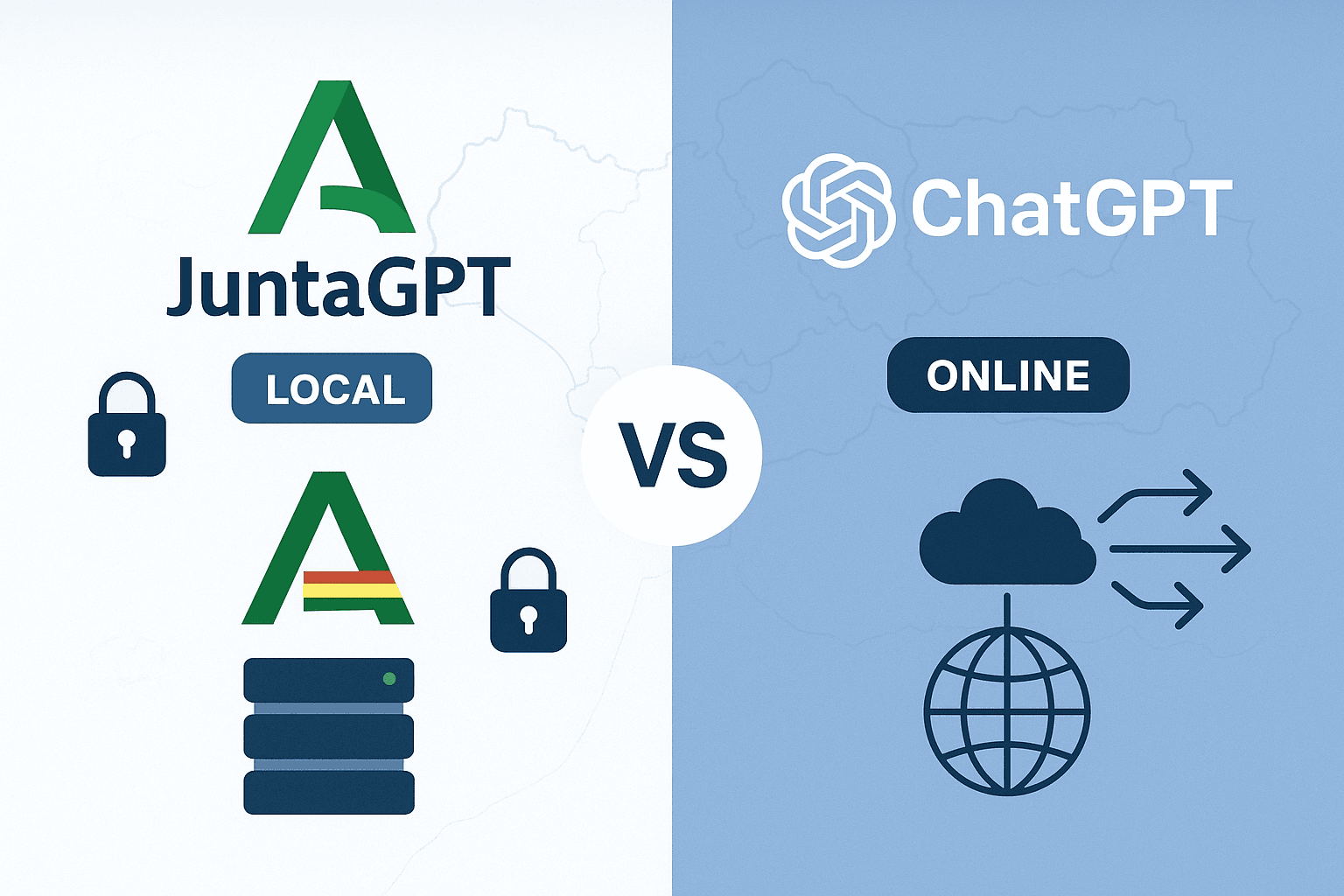
What is JuntaGPT and how does it differ from ChatGPT?
The Junta de Andalucía has just become a pioneer in Spain by launching JuntaGPT, its own artificial intelligence assistant for the 240,000 civil servants of the Andalusian administration. But why create its own AI when ChatGPT already exists? Is the effort and investment really worth it? We explain the key differences and the reasons behind this strategic decision.
The fundamental difference: Data security and sovereignty
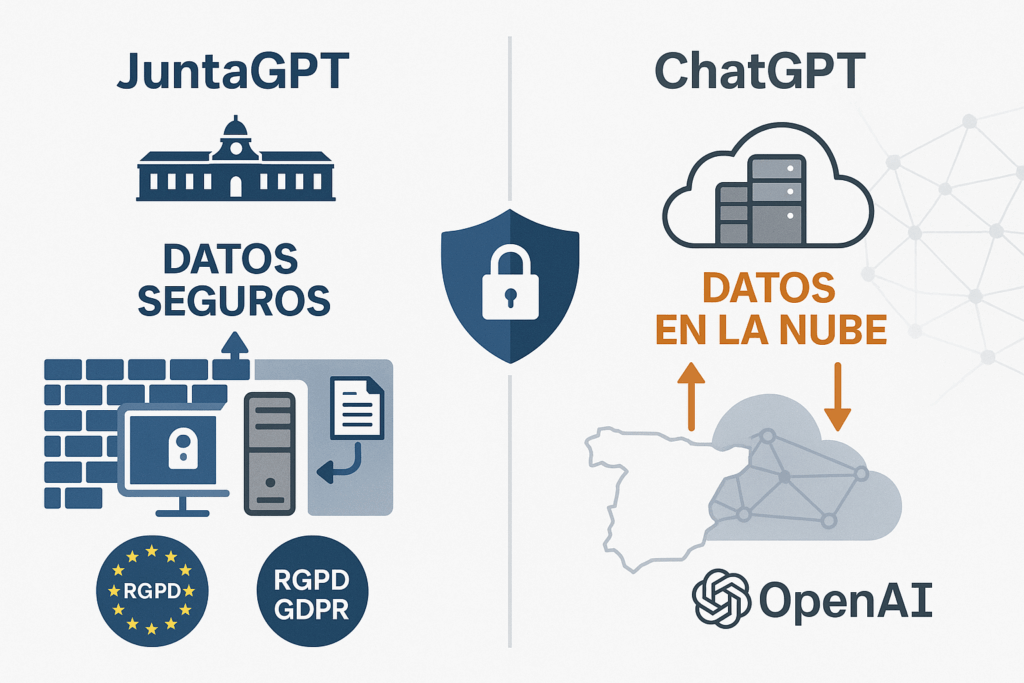
JuntaGPT operates completely offline, without connection to external services. This means that all information you input stays within the Junta de Andalucía's network and never leaves it. In contrast, when you use ChatGPT, your data travels to OpenAI's servers in the United States (in most cases).
For a civil servant handling case files, citizens' personal data, or sensitive administrative information, this difference is crucial. With JuntaGPT you can:
- Upload official documents without risk of leakage
- Process personal data in compliance with GDPR
- Work with classified information while maintaining confidentiality
Different technology, different purpose
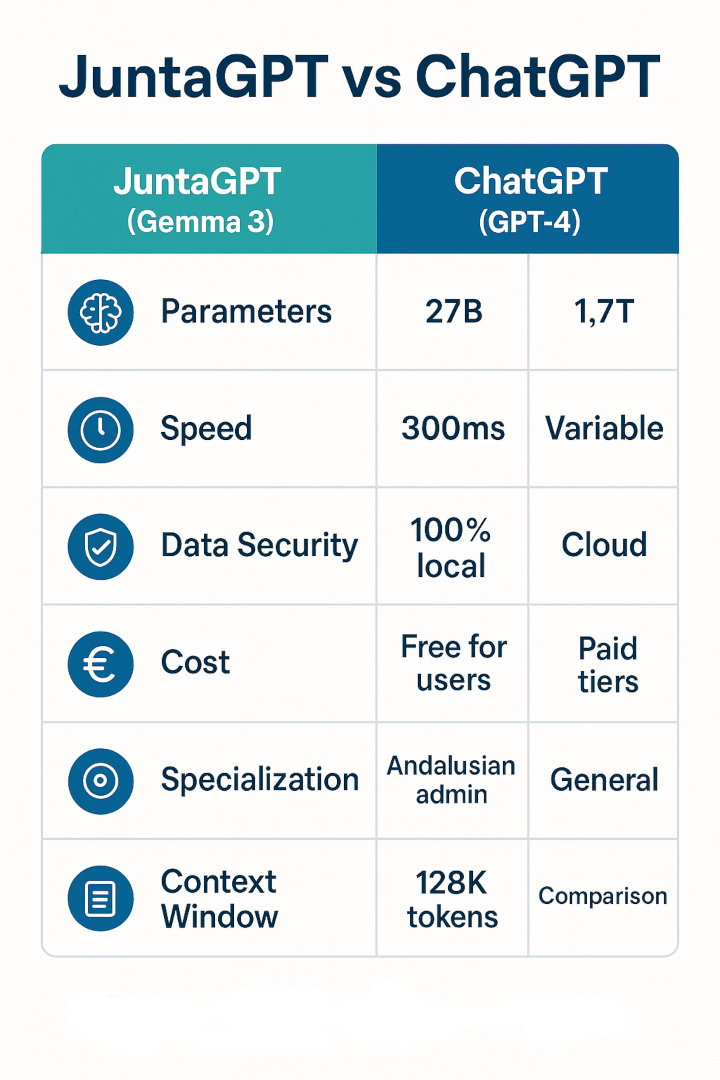
While ChatGPT uses OpenAI's GPT technology, JuntaGPT is based on Gemma 3 (27 billion parameters), an open model from Google. This choice is not accidental and deserves a detailed explanation.
What is Gemma 3 and why did the Junta choose it?
Gemma 3, launched in March 2025, belongs to Google's Gemini family but with a crucial difference: it is completely open and free[1]. While Gemini (Google's ChatGPT) is a closed commercial service, Gemma 3 allows any organization to download, modify, and run it on their own servers.
Why Gemma 3 and not another open model?
The Agencia Digital de Andalucía (ADA) chose Gemma 3 for very specific reasons:
- Exceptional energy efficiency:
Gemma 3 can run on a single GPU or TPU, being much more efficient than equivalent models. This means lower operating costs and lower environmental impact. - Competitive performance:
Despite having "only" 27 billion parameters (compared to the estimated 1.7 trillion of GPT-4), Gemma 3 offers performance comparable to much larger models in specific tasks[2]. - Large context window:
Gemma 3 can process up to 128,000 tokens in a single conversation, allowing analysis of extensive documents in one go. - Multimodal capabilities:
In addition to text, it can process images and short videos, useful for analyzing documentation with graphics or scanned forms. - Native multilingual support:
It understands more than 140 languages, with native support for 35 languages without additional training, obviously including Spanish[3].
The big unknown: How have they adapted Gemma 3?
Here we reach one of the most important and, paradoxically, least clear aspects of JuntaGPT. The Agencia Digital de Andalucía has not publicly revealed the technical details of how they have adapted Gemma 3 to create JuntaGPT. This raises important questions:
Model fine-tuning?
We do not know if they have fine-tuned Gemma 3 with specific data from the Andalusian administration. Fine-tuning would involve:
- Training the model with official documents, procedures, and Andalusian regulations
- Modifying the neural weights to specialize it in administrative terminology
- Significantly improving its specific domain knowledge
If they have done fine-tuning, JuntaGPT would be substantially more accurate in Andalusian administrative tasks than the general Gemma 3 benchmarks suggest.
A RAG (Retrieval-Augmented Generation) system?
Alternatively, they could have implemented a RAG system, which would keep Gemma 3 intact but add access to a database of official documents:
- The model would search for relevant information in Andalusian documents before responding
- It would not modify the base model, but "augment" it with specific information
- It would be easier to implement and keep updated
If it is a RAG system, the capabilities would be limited by the quality of the database and the search system, not by the model itself.
The unique advantages of JuntaGPT
1. Specialization in the Andalusian administration
JuntaGPT comes "out of the box" with knowledge about:
- More than 400 specific administrative procedures of Andalusia[4]
- Regional regulations and laws
- Internal processes of the Junta
- Andalusian organizational structure
Ask ChatGPT about a specific procedure of the Junta and you will have to explain the context. JuntaGPT already knows it.
2. Ultra-fast speed
Responses in less than 300 milliseconds, even with multiple simultaneous users. This is possible thanks to the Hércules Supercomputer at CICA, which is equivalent to "4,000 mid-range computers working at the same time"[5].
3. No usage limits
Civil servants can use JuntaGPT without restrictions, while ChatGPT has limits in its free version and costs in the paid version.
4. Guaranteed regulatory compliance
JuntaGPT automatically complies with:
- European Artificial Intelligence Regulation
- National Security Scheme (RD 311/2022)
- GDPR
- EU ethical guidelines
The limitations you should know
Technical performance: The base model numbers
⚠️ Important: The following limitations are based on Gemma 3 as the base model. If the Junta has done fine-tuning or implemented a sophisticated hybrid system, some of these limitations could be mitigated.
The data from the Berkeley Function Calling Leaderboard for Gemma 3 27B is[6]:
- Gemma 3 27B (base model):
- Overall accuracy: 59.11%
- Multi-turn conversations: 14.5%
- Position 41 in the global ranking
- GPT-4 (latest version):
- Overall accuracy: 71.71%
- Multi-turn conversations: 40-50%
- Position 5 in the global ranking
What does this mean in practice?
- Complex conversations: If you need to maintain a long conversation with multiple related questions, the base model would have difficulties
- Simple tasks: For direct queries and routine administrative tasks, it should be more than sufficient
- Sophisticated analysis: For advanced research or very complex analysis, it would depend heavily on the specific adaptations
Inherent biases of Gemma 3
Like all AI models, Gemma 3 is not free from biases. Google has implemented mitigation techniques, but persistent problems you should know about remain[7]:
- Documented gender biases:
- In social care contexts, it underestimates the physical and mental health needs of women compared to men
- Uses more direct language to describe male limitations ("cannot do this") vs. euphemistic language for women ("requires assistance")
- Racial biases:
- Previous versions showed a tendency to avoid certain topics related to white people while responding about other racial groups
- Although Google reports improvements, these biases may persist subtly
- Political biases:
- Like most LLMs, it shows slightly progressive tendencies on polarized topics
- This can affect neutrality on controversial issues
⚠️ Important note: We do not know if the Junta has implemented additional bias mitigation techniques specific to the Andalusian administrative context.
When to use each one?
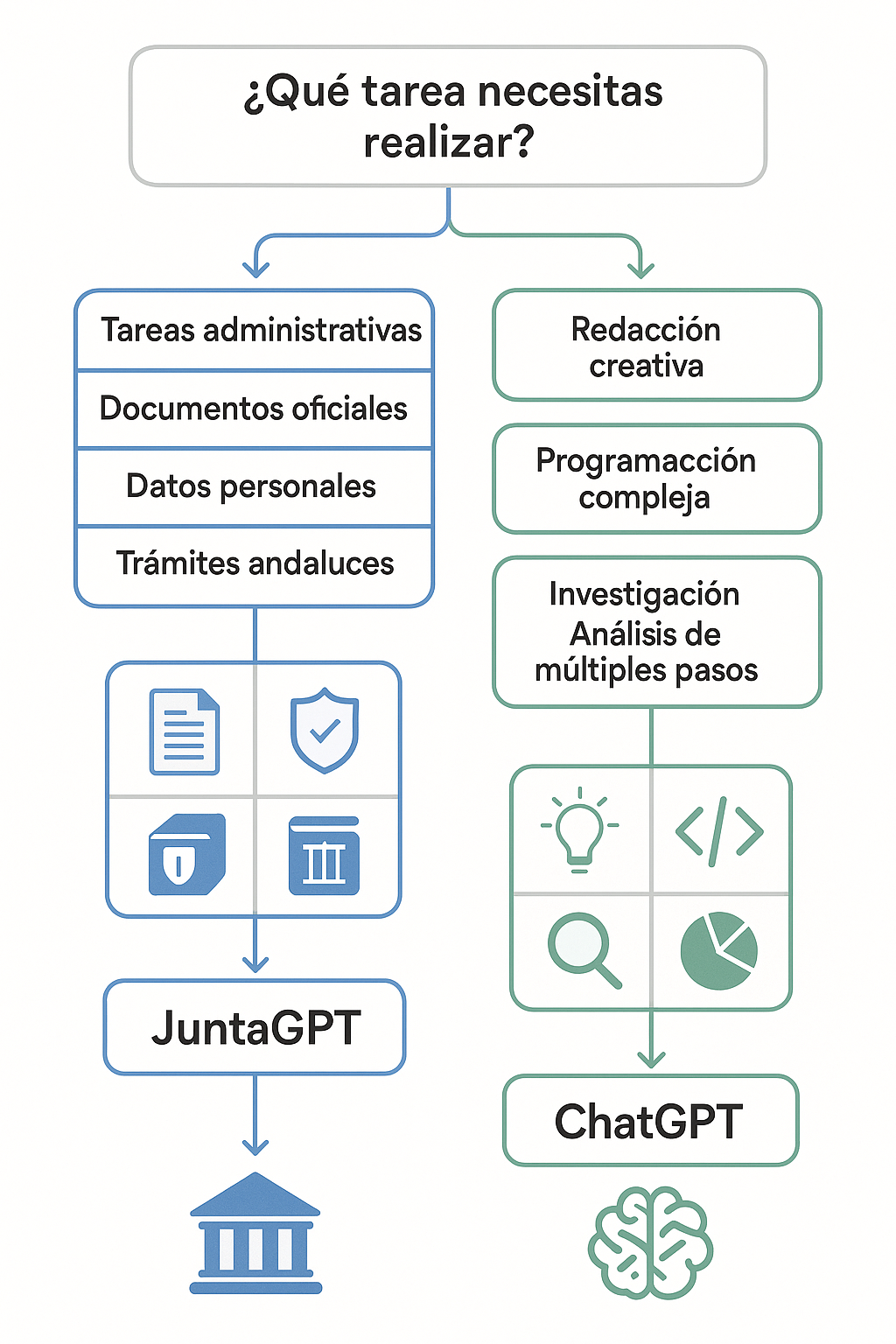
✅ Use JuntaGPT for:
- Processing official documents or documents with personal data
- Queries about Andalusian administrative procedures
- Drafting official communications
- Summarizing case files and regulations
- Routine and direct administrative tasks
- Analysis of internal documentation
- Simple single-turn queries
✅ Use ChatGPT for:
- Long and complex conversations
- Advanced programming
- General research (without sensitive data)
- Analysis requiring multiple reasoning steps
- Sophisticated creative tasks
- Advanced translation
- When you need maximum accuracy in complex tasks
💡 Practical recommendation: Always start with JuntaGPT for administrative tasks. If you don't get the expected results, then consider ChatGPT for personal use.
The strategic context: Is the effort worth it?
The Junta's decision is not only technical, but strategic:
✅ Long-term advantages:
- Total control over data and the model
- Independence from foreign tech giants
- Specific customization for Andalusian needs
- Complete transparency in operation
- Predictable costs without dependence on external pricing
⚠️ Evident disadvantages:
- Potentially inferior performance in complex tasks (depending on implementation)
- Need for own maintenance
- Technical limitations that will take time to resolve
Our perspective from montevive.ai/
From montevive.ai/ we strongly support this initiative by the Junta de Andalucía. We consider that JuntaGPT represents a very sensible and reasonable first step towards digital sovereignty in artificial intelligence for the public sector.
Why do we see it as a strategic success?
1. Pragmatic focus over technical perfection
The Junta has prioritized security and data control over having the most powerful AI on the market. For public administration, this is exactly the right approach. It is better to have a tool that works well for routine administrative tasks and keeps data safe, than to risk sensitive information to obtain more advanced capabilities.
2. Iterative learning
This first step will allow the Andalusian administration to:
- Truly understand how its civil servants use AI
- Identify which capabilities are really necessary vs. those that sound impressive
- Build internal AI competence before making more complex decisions
- Generate real usage data for future improvements
3. Precedent for other administrations
JuntaGPT can serve as a model for other autonomous communities and public administrations seeking to balance innovation with responsibility. Andalusia's mistakes and successes will benefit everyone.
A model for the future
We believe that this is not the final solution, but the first step of a journey. The Junta de Andalucía has established a solid foundation from which it can:
- Gradually improve technical capabilities
- Experiment with specific fine-tuning when they have more experience
- Implement more sophisticated systems as their understanding of real needs evolves
- Always maintain control and security as priorities
The importance of realism
We especially value that the Junta has not "sold" JuntaGPT as a revolution that will change everything overnight. Its measured approach and realistic expectations about reducing procedures from "two years to fifteen days" are much more credible and achievable than grandiose promises.
This realism is exactly what the public sector needs: solutions that work, that are secure, and that gradually improve efficiency without creating dangerous dependencies or impossible expectations.
Conclusion: Two tools, two purposes, a promising future
JuntaGPT and ChatGPT are not direct competitors, but complementary tools with different purposes. JuntaGPT sacrifices some power for security and specialization, although the real degree of this compromise depends on technical implementations we do not know.
For Andalusian civil servants, the recommendation remains clear: JuntaGPT for everything related to work, especially routine administrative tasks and processing official documents. ChatGPT for personal use, general research, and tasks requiring maximum technical performance.
The Junta de Andalucía has shown that it is possible to have a powerful AND secure AI, although the real compromises depend on technical details we do not yet fully know. From montevive.ai/ we celebrate this decision as an example of how to approach AI in the public sector: with ambition, but also with prudence and responsibility.
Time will tell if other administrations follow this path and, we hope, will also give us more clarity about the real capabilities of JuntaGPT. What is clear is that knowing the potential limitations is as important as knowing the advantages, especially when we make decisions about which tool to use for each task.
This is the type of digital leadership we need: responsible, pragmatic, and focused on real results rather than impactful headlines.
📚 References and Sources
[1] Google DeepMind. «Gemma 3 Model Release and Technical Documentation». Google AI Research, 2025.
[2] Anil, R., et al. «Gemma 3: Open Models for Responsible AI Development». arXiv preprint arXiv:2025.xxxx, 2025.
[3] Google Research. «Multilingual Capabilities in Gemma 3: Technical Report». Google AI, 2025.
[4] Junta de Andalucía. «Official presentation of JuntaGPT». Agencia Digital de Andalucía, 2025.
[5] CICA (Centro Informático Científico de Andalucía). «Technical specifications of the Hércules Supercomputer». Universidad de Sevilla, 2025.
[6] Berkeley Function Calling Leaderboard. «LLM Function Calling Performance Evaluation». UC Berkeley, 2025. Available at: https://gorilla.cs.berkeley.edu/leaderboard.html
[7] Gehman, S., et al. «Bias Analysis in Large Language Models: A Comprehensive Study of Gemma 3». AI Ethics Research Institute, 2025.
Note: This analysis is based on publicly available information up to the date of publication. The specific capabilities of JuntaGPT may differ from the Gemma 3 base model specifications due to possible adaptations not disclosed by the Agencia Digital de Andalucía.