
From Prototype to MVP: Agentic AI and the New Development Bottleneck
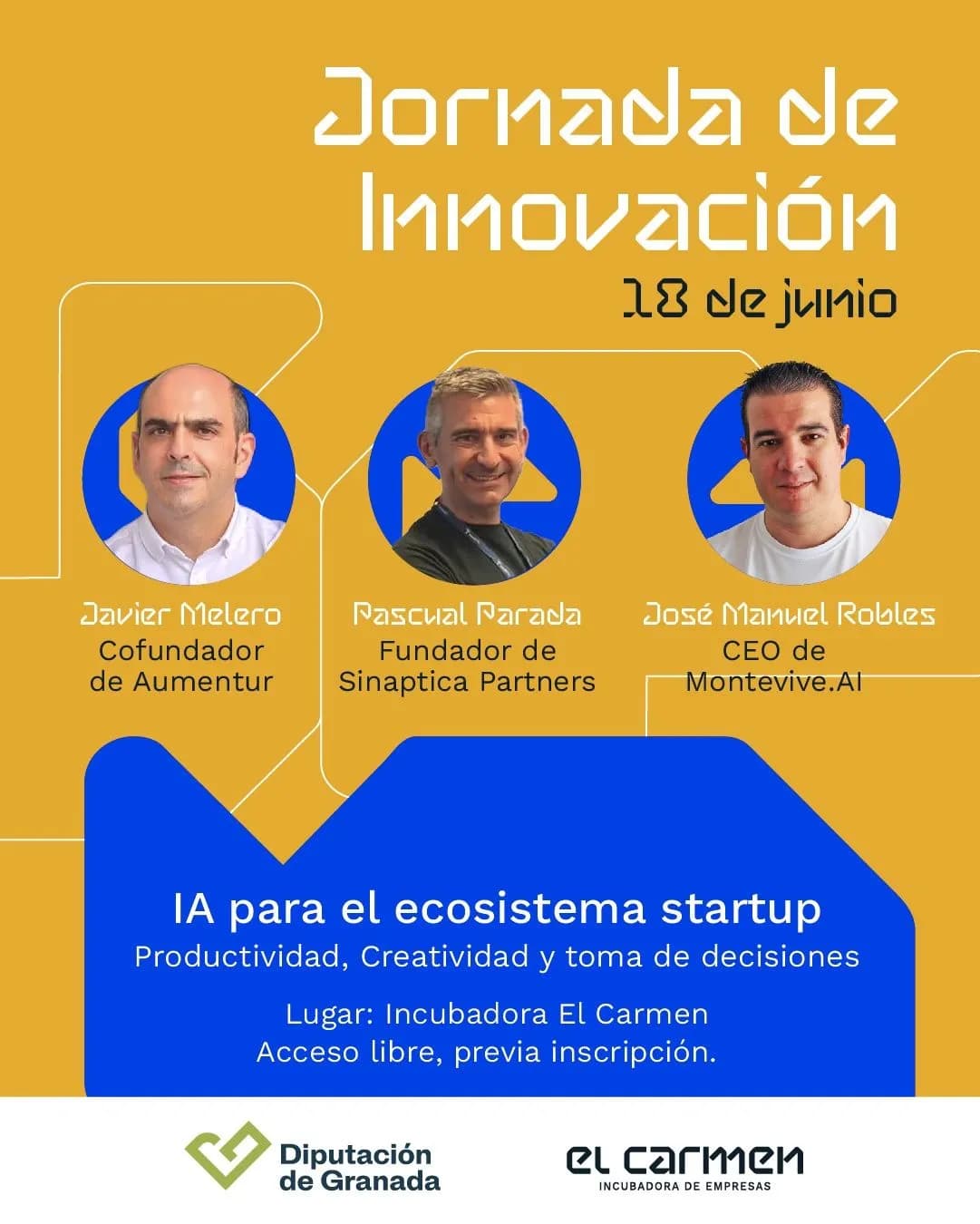
On June 18, 2026, in the heart of Granada's entrepreneurial ecosystem, I had the opportunity to share a thesis I'd been developing for some time: writing code is now trivial. What used to be the development bottleneck has become a commoditized task thanks to AI. And as with every technological revolution, when you solve one problem, the next surfaces.
That's how I opened my talk "Agentic Code AI: From Prototype to MVP" at the III Innovation Days of the El Carmen Incubator, an event organized by the Granada Provincial Council and Telefónica that brought together startups, mentors, and ecosystem leaders to discuss how artificial intelligence is transforming entrepreneurship.
The Bottleneck Has Moved (And Nobody Told You)
Decades ago, compilers freed us from assembly language. They didn't eliminate programmers; they made them more productive and allowed them to think at a higher level of abstraction. Agentic AI does the same today: it dramatically boosts development productivity, but shifts the hard work elsewhere.
Where's the bottleneck now?
- Upstream: Specifying what to build correctly (what problem does this actually solve?)
- During: Verifying that the code works and is secure (can I trust this?)
- After: Learning from the market if anyone actually wants it (is this useful for anything?)
What's scarce today isn't typing speed. It's specification with judgment, verification with rigor, and market instinct.
The Tools Map: Three Phases, Three Approaches
During the talk, we toured the AI development tools ecosystem according to project phase:
1. Prototype Without Code
To validate ideas quickly without writing a single line:
- Lovable: Conversational interfaces that generate functional apps
- Bolt.new: Instant visual prototyping
- v0.dev: React components from natural language prompts
When to use them: Validate hypotheses, explore UX, convince early stakeholders.
2. Build the MVP with Agents
When you need real, maintainable, scalable code:
- Claude Code: Conversational agent that understands complex architecture
- Cursor: Editor powered with full project context
- GitHub Copilot Workspace: Human-AI collaborative development
When to use them: Implement the real product, iterate features, maintain legacy code.
3. Industrialize with Spec-Driven Development
When the project matures and needs control, traceability, and quality:
- Specification as source of truth: Code is the output, not the input
- Automated tests from specs: Playwright, Jest, Cypress generated from requirements
- Code review and security: SAST/DAST integrated in CI/CD
When to use it: Products in production, distributed teams, regulatory requirements.
Spec-Driven Development: The Answer to "Vibe Coding"
One of the talk's core concepts was Spec-Driven Development as an antidote to "vibe coding" chaos. When you ask AI "make me a task management app with authentication," the result might be functional... or not. And if it doesn't work, was it because the prompt was ambiguous or the model hallucinated?
In the spec-driven approach:
- You formally specify what the system should do (use cases, flows, business rules)
- AI generates code that meets the specification
- Tests automatically verify that code implements the spec
- Code passes reviews for security and quality (SAST, DAST, linters)
The specification is the single source of truth. Code is a derived artifact.
The Data Doesn't Lie: AI Accelerates, But Creates Risks
During the talk I shared data illustrating the current dilemma:
- +70% productivity in lines of code written (GitHub, 2026)
- 1.7x more incidents in AI-generated vs. human-written code (Uplevel, 2026)
- +91% more time in Pull Request reviews with AI code (Stack Overflow, 2026)
- 96% of developers don't fully trust AI-generated code (Stack Overflow Developer Survey 2026)
The contradiction is clear: we're moving faster, but trusting less. And when code goes to production, "trusting less" isn't an option.
The Demo That Built Itself
The talk's centerpiece was a live demo. With a single prompt, I launched an AI agent to build the "El Carmen Opportunities Radar": a real application that aggregates and monitors incubator opportunities. While this is a textbook anti-pattern, the goal was to demonstrate how AI can generate code that previously took hours in minutes.
While I continued talking, the agent:
- Designed the architecture (Next.js + TypeScript + SQLite)
- Implemented frontend and backend
- Generated E2E tests with Playwright
- Ran static code analysis (ESLint, TypeScript checks)
- Passed security review (dependencies, known vulnerabilities)
- Deployed a functional preview
Without human intervention. Without debugging. Without "wait, let me fix this."
The audience could try the app on their phones before the talk ended. And that, just a year ago, would have required a development team for weeks.
(Spoiler: the app seemed to work... but it didn't work well. Something expected from having no human intervention or judgment)
The New Development Economics: From Teams to Individuals, From Months to Days
For the founders present, the message was clear: software development economics have changed radically.
Before (2023-2024):
- A team (frontend, backend, QA)
- Several months of development
- Budget of €30-80K for an MVP
Now (2026):
- One person with technical judgment
- Days or weeks (not months)
- Budget dominated by infrastructure and validation, not salaries
But here's the trick: code is no longer your competitive moat.
If you and your competitor use Claude, Cursor, or Copilot, you're using "the same brain." Competitive advantage has shifted to:
- Proprietary data: What unique information do you have that AI can exploit?
- Optimized workflow: How do you orchestrate humans + AI to iterate faster?
- Distribution: How do you reach users before the competition?
- Brand and trust: Why will they choose you if everyone has the same tech stack?
Roundtable: Judgment and Governance in the AI Era
After the talk, I participated in a roundtable with Javier Melero, Pascual Parada, and Juan Carlos, where we explored a fundamental question: how not to lose judgment when AI changes everything?
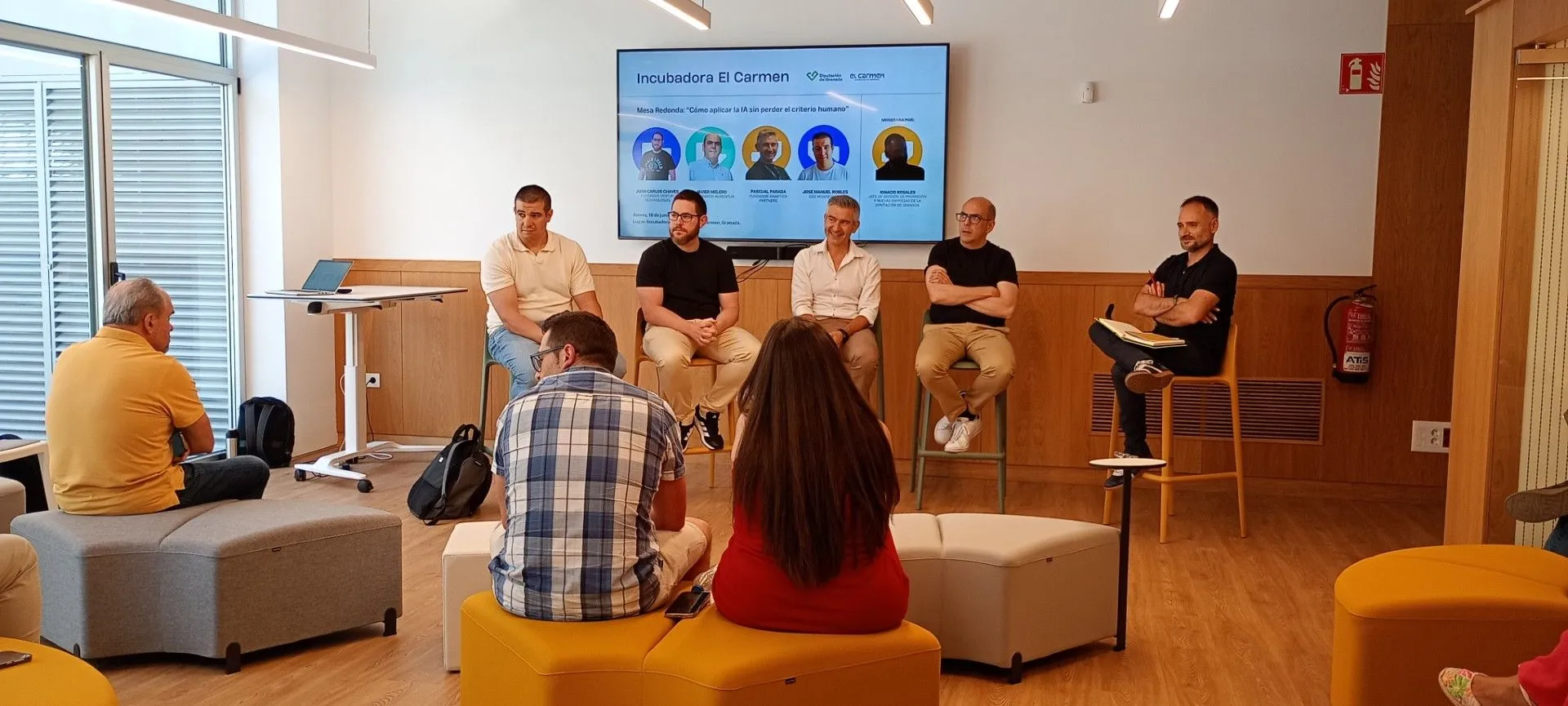
Some themes that emerged:
Judgment vs. Automation
- AI doesn't eliminate the need for judgment; it amplifies it
- Bad judgment executed at AI speed is a faster catastrophe
- Founders must continue understanding the problem they solve, not just delegate to the machine
AI Governance in Startups
- Startups can't afford compliance teams, but can't ignore regulation either (EU AI Act, GDPR)
- Automated auditing and explainability tools are essential
- Traceability of AI-generated code will be a legal requirement in regulated sectors
The Technical Founder's Role in 2026
- No longer "the best programmer," but the best specifier, verifier, and decision-maker
- Ability to read and audit AI code is more valuable than writing from scratch
- The technical founder is the translator between business problem and solution architecture
Lessons for Entrepreneurs: What To Do With This?
If you're a tech startup founder in 2026, here are the practical takeaways:
1. Prototype with AI, But Don't Marry the Code
No-code/low-code tools are brilliant for validation. But if your prototype works, don't scale it. Rebuild with real architecture.
2. Invest in Specification, Not Just Implementation
A clear specification document is worth more than 10,000 lines of ambiguous code. Tools like TypeSpec, OpenAPI, or Gherkin (BDD) are your allies.
3. Automate Verification from Day 1
Don't wait to have technical debt. Integrate:
- Automated tests (unit, integration, E2E)
- Static analysis (linters, type checkers)
- Security review (SAST, dependency scanning)
4. Code Isn't Your Moat, But Data Is
If your competitive advantage is "we have better code," you've already lost. If it's "we have data nobody else has and we know how to use it," you're in the game.
5. Learn to Audit AI Code
You'll receive thousands of machine-generated lines. You need to know:
- Are there obvious vulnerabilities? (SQL injection, XSS, hardcoded secrets)
- Does the code do what it says? (tests, logic review)
- Is it maintainable? (documentation, readability, modularity)
The El Carmen Experience: Andalusian Entrepreneurial Ecosystem
The III El Carmen Innovation Days showcased Granada's entrepreneurial talent. The El Carmen Incubator, promoted by Granada Provincial Council and Telefónica, is consolidating as one of Andalusia's reference spaces for startups.
Although the event was open, incubated projects making a difference were also there:
- GeoNotary: Legaltech applying blockchain to notarization
- eubiOmic Health: AI applied to personalized health
- Urbanodo: Smart urban management solutions
- Aixa AI: AI tools for vertical sectors
- RHAI Systems: Deterministic AI hardware for critical environments
Granada is proving you don't need to be in Madrid or Barcelona to build first-tier tech startups. The ecosystem is here, tools are democratized, and talent is local.
Conclusion: AI Took Away the Easy Part and Left You the Hard Part
The great irony of agentic AI is that it frees you from typing to force you to think.
You no longer need to be a TypeScript ninja or a React wizard. But you do need:
- Know what to ask for: Specify the problem you solve well
- Verify it works: Verify the code does what it promises
- Measure if it works: Validate in the real market, with real users
Code is increasingly commodity. Judgment, increasingly scarce.
And that, paradoxically, is great news for founders who understand that building software isn't the goal; solving problems is.
Want to Learn More?
At Montevive AI we help startups and companies integrate AI securely, privately, and effectively. If you're building your MVP and want:
- AI architecture that scales (without vendor lock-in)
- AI-generated code auditing
- Spec-driven development implementation
- EU AI Act and GDPR compliance
Let's talk → Free 30-minute consultations for startups in the Granada ecosystem.
Were you at the III El Carmen Innovation Days? What did you think? Tell us on LinkedIn or X.