
AI Act Article 50: what to disclose for chatbots and generative AI
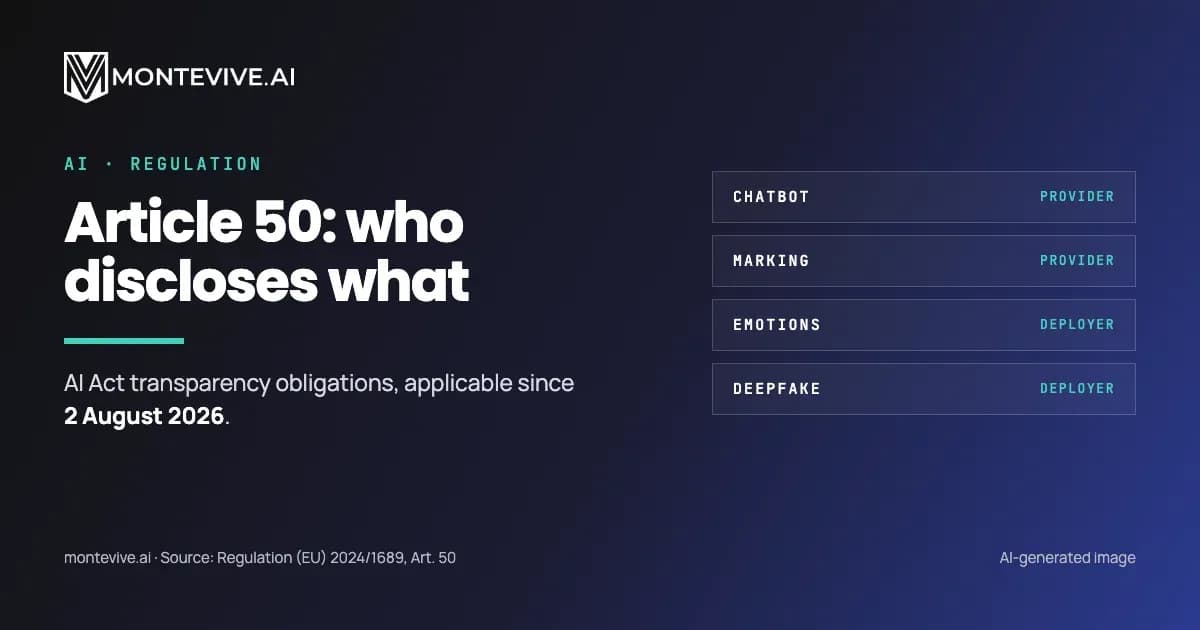
In short. Since 2 August 2026, Article 50 of the AI Act requires you to tell people when they are talking to an AI, when a system analyses their emotions or biometric traits, and when they see a deep fake or AI-generated text on matters of public interest. On top of that, whoever offers generative AI must mark its output so it can be detected. Text that a person has thoroughly reviewed and signed needs no label; an image or video that could pass as real does.
Contents
- What Article 50 of the AI Act requires you to disclose, and since when
- When your company is the one that must disclose that the chatbot is an AI
- What a chatbot notice must look like to comply with Article 50
- Which AI-generated content must be labelled and which need not be
- What your generative AI provider must mark and what to ask them
- When you must disclose emotion recognition or biometric categorisation
- What happens if you do not disclose, and who supervises it in Spain
- What the Commission and the code of practice have clarified
- What to do on Monday morning
- Frequently asked questions
What Article 50 of the AI Act requires you to disclose, and since when
The Article 50 transparency obligations of the AI Act are the notices and markings that Regulation (EU) 2024/1689 requires when people interact with an AI or receive content generated or manipulated by it.
They apply from 2 August 2026, the general date of application set by Article 113 of Regulation (EU) 2024/1689. The Digital Omnibus on AI, Regulation (EU) 2026/1744, did not move that date. It only gave some providers until 2 December 2026 to mark synthetic content.
The article splits four notices between two roles. The provider is whoever develops the system, or has it developed, and puts it into service under their own name or trademark. The deployer is whoever uses it in their professional activity.
| Paragraph | Case | Who discloses | What they must do | Since |
|---|---|---|---|---|
| 50(1) | Systems that interact with people: chatbots, voice assistants, agents that reply | Provider | Design it so people know they are talking to an AI | 2 Aug 2026 |
| 50(2) | Systems that generate synthetic audio, image, video or text | Provider | Mark the output in a machine-readable format | 2 Aug 2026 (2 Dec 2026 for systems already on the market) |
| 50(3) | Emotion recognition and biometric categorisation | Deployer | Inform the people exposed | 2 Aug 2026 |
| 50(4) | Deep fakes, and text that informs the public on matters of public interest | Deployer | Disclose that the content is artificial | 2 Aug 2026 |
Paragraph 5 adds how the notice is given: clearly and distinguishably, at the latest at the first interaction or exposure, and in line with accessibility requirements.
What the rest of the AI Act requires and the full timeline are covered in AI Act in Spain: the national law has lapsed and the timeline continues.
When your company is the one that must disclose that the chatbot is an AI
Your company must disclose that the chatbot is an AI when it is the chatbot's provider. And it is the provider if it has developed the chatbot, or had it developed, and puts it into service under its own name or trademark, whether for payment or free of charge.
That is the definition in Article 3(3) of the AI Act, and it has a consequence that often goes unnoticed. If an agency builds you an assistant on top of an OpenAI or Anthropic model and you publish it on your website as "your brand's assistant", you are the provider of that chatbot for the purposes of paragraph 1. OpenAI and Anthropic are providers of the model, with their own obligations.
There are three common situations:
- Your own or custom-built chatbot, under your brand. You are the provider. The notice is your responsibility.
- A customer service vendor's widget that you configure and that displays the vendor's brand. The provider of the system is that platform, and it is up to the platform to design it so that it discloses. You are the deployer.
- A third-party widget that you customise with your name, logo and tone. Grey area. The more it looks like yours, the harder it is to argue that someone else is the provider.
Our recommendation is the same in all three cases: add the notice. In the first case it is mandatory. In the other two it costs one line of text and saves you an argument about who should have added it.
At Montevive AI we know both sides. Under our own brand we built Nazareno.chat, the Holy Week assistant for Granada, for three channels at once: Telegram, WhatsApp and our own web app. And for Gridfy we built Gridfy.Lex, an electricity-regulation assistant that Gridfy offers under its own brand: there, the provider is Gridfy.
What a chatbot notice must look like to comply with Article 50
For a chatbot notice to comply with Article 50 of the AI Act, the person must see it before or at the moment of the first interaction, it must stand out from the rest of the text, and it must be accessible. Paragraph 5 says so, and it applies to all four notices in the article.
The regulation does not prescribe a wording. It sets three conditions, and each one leads to a design decision:
| Article 50(5) condition | What it means in practice |
|---|---|
| Clear and distinguishable | The notice goes in the conversation itself, formatted so it is visible. A link to the privacy policy is not enough |
| At the latest at the first interaction | In the widget header or in the first message. A notice halfway through the conversation comes too late |
| Accessible | Readable by a screen reader, and on a voice channel, heard when the call starts |
An example of wording that meets all three conditions on a website:
"Hi, I'm [your company]'s virtual assistant. I'm an artificial intelligence system, not a person. If you'd rather talk to someone on the team, type 'person'."
Article 50 does not require the last sentence. We include it because it answers the customer's next question before they ask it.
Paragraph 1 has an exception: no notice is needed when it is obvious that it is an AI from the point of view of a reasonably well-informed, observant and circumspect person. It is best not to rely on it. An assistant that writes like a person, with a first name and a photo, is exactly the case where it is not obvious. Recital 132 also asks for vulnerable groups, due to age or disability, to be taken into account when the system is also aimed at them.
Each channel has its weak spot:
- Web. According to the Commission's guidelines, a prominent notice when the chat opens is usually enough. A fixed notice in the widget header is safer, and it is what the Commission recommends when vulnerable users or sensitive topics are involved.
- WhatsApp and other messaging apps. There is no header you control: the notice goes in the bot's first message.
- Phone. The notice must be heard when the call starts.
- Email answered by an agent. If an AI agent replies to customer emails without a person reviewing them, the prudent reading is to treat it as direct interaction and disclose it in the message itself.
Which AI-generated content must be labelled and which need not be
Under the AI Act, a company that uses generative AI only has to label content in two cases, according to Article 50(4): deep fakes, and text published to inform the public on matters of public interest that nobody has reviewed with editorial responsibility.
The AI Act defines a deep fake in Article 3(60) as AI-generated or manipulated image, audio or video content that resembles existing persons, objects, places, entities or events and would falsely appear to a person to be authentic or truthful.
For text, the exception matters as much as the rule. No notice is needed if the content has undergone human review or editorial control and a natural or legal person holds editorial responsibility for the publication. According to the Commission's guidelines, that review must be substantive and check accuracy: a spell check, or simply having an editorial policy, is not enough.
| Case | Notice required under Article 50(4)? | Why |
|---|---|---|
| LinkedIn post drafted with AI help, reviewed and published by a person | No | A person reviews it thoroughly and someone is responsible for what is published |
| Blog article signed by a team member | No | Same exception: review and editorial responsibility |
| Industry news generated and published automatically, without review | Yes | Text that informs the public, without editorial control |
| Realistic AI-generated photo of a person, place or event that looks real | Yes | It is a deep fake |
| Video with the CEO's cloned voice | Yes | Audio that resembles a real person |
| Deep fake in a clearly creative, satirical or fictional piece | Yes, in a way that does not spoil the work | Paragraph 4 lightens the notice for creative, satirical or fictional works, but does not remove it |
| Illustration that is clearly an illustration | No | It cannot be mistaken for something authentic |
| Proofreading, translating or summarising your own text for internal use | No | It is not a deep fake and it is not published to inform the public |
Not being required to disclose by Article 50 does not mean you should not. At Montevive AI, our editorial policy requires "AI-generated image" on every blog cover made with AI, even though none of them is a deep fake.
What your generative AI provider must mark and what to ask them
Marking synthetic content is the job of the provider of the generative AI system, under Article 50(2) of the AI Act. The provider must mark its output in a machine-readable format so that it can be detected as artificially generated.
If you use ChatGPT, Gemini, Copilot or an image generator, that obligation falls on the provider of the system (OpenAI, Google, Microsoft…). Recital 133 lists possible techniques: watermarks, metadata identification, cryptographic methods for proving provenance, and logging methods, among others. Note: if you are the provider of your chatbot, marking the text it generates is also your job, as far as technically feasible.
Providers of systems already on the market before 2 August 2026 have until 2 December 2026 to comply. That is the new Article 111(4), added by Regulation (EU) 2026/1744. The extension only covers marking. The other notices (paragraphs 1, 3 and 4) have applied since 2 August 2026.
Marking does not apply either when the system only performs standard editing or does not substantially alter what you give it. Correcting the spelling of a text or cropping a photo does not generate synthetic content for the purposes of paragraph 2.
Five questions for your generative AI providers:
- Do you mark the text, images, audio and video your tool generates? All of it or only part?
- With what technique: metadata, watermarking, a provenance standard such as C2PA?
- Does the marking survive if I export, compress or edit the file?
- If your system was already on the market before 2 August 2026, will you comply by 2 December 2026?
- What do I need to do to avoid removing the marking by accident?
The third one is the most useful. Many editing tools and social networks strip metadata when a file is uploaded. The obligation to mark lies with the provider, but if your workflow removes the marking, you should know.
When you must disclose emotion recognition or biometric categorisation
You must disclose it when your company uses a system that, based on biometric data, infers emotions or intentions, or assigns people to categories such as age or sex (examples from Recital 132). Article 50(3) requires this of the deployer, who must also process that data in line with the GDPR.
It is the least discussed notice, and it shows up in uses that are not perceived as biometrics. For example, analysing customers' voices in a call centre to measure their frustration (if it also analyses your agents, it falls under the prohibition explained just below), or shop cameras that estimate the age and sex of whoever walks in.
Before thinking about the notice, check that the use is allowed. Emotion recognition in the workplace and in educational institutions has been a prohibited practice since 2 February 2025 under Article 5(1)(f) of the AI Act, except for medical or safety reasons. If the system analyses your staff, a notice does not fix it: it has to be withdrawn.
What happens if you do not disclose, and who supervises it in Spain
Breaching the Article 50 transparency obligations can cost up to EUR 15 million or 3 % of total worldwide annual turnover, whichever is higher. That is the bracket in Article 99(4)(g) of the AI Act.
For SMEs and start-ups, Article 99(6) applies whichever of the two is lower, and since the Omnibus the new Article 99(6a) does the same for small mid-cap enterprises. For an SME with a turnover of EUR 10 million in the previous year, the theoretical maximum is 3 %: EUR 300,000. The amount depends on gravity, duration and intent, among the other criteria in Article 99(7).
In Spain, the reference authority is the Spanish Agency for the Supervision of Artificial Intelligence (AESIA). If the system is based on a general-purpose model from the same provider, such as ChatGPT or Gemini, the notice and marking are supervised by the Commission's AI Office. Spain's national regime of infringements and penalties is still pending: it was part of a bill that lapsed on 6 October 2026 when Parliament was dissolved. How a case under Article 50 would be handled in Spain today is an open question, and we will not pretend it is settled. We explain it in AI Act in Spain: the national law has lapsed and the timeline continues.
What does not depend on that law is the GDPR. If your chatbot processes personal data, the Spanish Data Protection Agency (AEPD) can act today under the GDPR, as always.
What the Commission and the code of practice have clarified
Article 50 has applied since August 2026, and some of the pieces that help interpret it have only recently been settled, while others remain open:
- The code of practice on marking and labelling. The Commission published it on 10 June 2026 and in July found it adequate for paragraphs 2, 4 and 5. It is voluntary, but signing it is the simplest way to show that you comply.
- The Commission's guidelines on Article 50. The Commission published them in July 2026 and they appeared in the Official Journal on 12 November. They are not binding, but they clarify a lot: the chatbot notice must be given at the start, putting it in the terms and conditions is not enough, and human review of a text must be substantive.
- What a "matter of public interest" is. The regulation does not define it, but the guidelines do: politics, public services, health, consumer safety, or any economic or financial development that may be publicly debated. An investor report is in; an advert or a product description without health or sustainability claims is not.
- Realistic images of people who do not exist. The guidelines settle it: a realistic AI-generated person counts too, even if they do not exist. An AI-generated photo of a made-up employee on a corporate website must be labelled.
What to do on Monday morning
01 · List your AI touchpoints. Website chatbots, WhatsApp bots, automatic email replies, voices on the switchboard. Note who built each one and under which brand it appears.
02 · Decide for each one whether you are the provider or the deployer. If it carries your brand and you commissioned it, treat it as yours.
03 · Add the notice at the first interaction of every chatbot and voice assistant, adapting the example wording to each channel.
04 · Review what content you generate and publish. Put in writing who thoroughly reviews and signs AI-generated content: for text on matters of public interest, that is the condition for not having to label it. An editorial policy is not enough if nobody actually reviews. Label deep fakes, without exception.
05 · Send the five questions to your generative AI providers before 2 December 2026.
More articles on the AI Act and ISO 42001 in our regulation section.
Frequently asked questions
Do I have to disclose that I used ChatGPT to write an email to a customer?
Not under Article 50 of the AI Act. An email drafted with AI help and sent by a person is not an interaction with an AI system, a deep fake, or text published to inform the public. If an AI agent replies to emails without anyone reviewing them, the prudent reading is to disclose it.
Is it enough to mention AI in the privacy policy or the terms of use?
No. Article 50(5) requires the notice to be clear and distinguishable and to reach the person at the latest at the first interaction or exposure. A link to a legal document the person has not opened meets neither condition.
If my chatbot vendor already discloses, do I need to do anything else?
Check that the notice is visible on your website, in your channel and in your language, because the configuration can hide it. If you have customised the chatbot with your name and brand, assume the notice is your responsibility.
Do AI-generated images used in advertising need a label?
Only if they are a deep fake: a realistic image of people, places, objects or events that could pass as authentic, even if the person does not exist. An obvious illustration does not need one. In a creative or satirical work, a notice that does not spoil the piece is enough.
Does the extension to 2 December 2026 affect me if I only use AI?
No. The Article 111(4) extension covers providers of generative systems already on the market before 2 August 2026, and only for the marking in paragraph 2. Your notices as a deployer have applied since 2 August 2026.
Sources
All consulted on 18 and 19 November 2026.
- Regulation (EU) 2024/1689 (AI Act), OJ of 12 July 2024: Articles 3(3), 3(4), 3(60), 5(1)(f), 50, 99 and 113, and Recitals 132 to 134. EUR-Lex.
- Regulation (EU) 2026/1744 (Digital Omnibus on AI), OJ of 24 July 2026: new wording of Article 50(7) and new Article 111(4). EUR-Lex.
- Regulation (EU) 2016/679 (GDPR). EUR-Lex.
- European Commission, Guidelines on the implementation of the transparency obligations for certain AI systems under Article 50, OJ C/2026/6005, 12 November 2026. EUR-Lex.
- European Commission, Code of Practice on Transparency of AI-generated Content, 10 June 2026, and the Commission opinion on its adequacy, 8 July 2026.
Rubén Sánchez Iruela is CTO and co-founder of Montevive AI. He leads the technical architecture of the systems the company takes into production, including its conversational assistants, and its methodology for security audits of AI agents. LinkedIn
Do you know how many AI touchpoints your company has, and who has to disclose in each one? Our AI Act assessment starts there. It usually takes two to four weeks, and the deliverable is an inventory of your AI uses classified by risk level, with the Article 4 and Article 50 obligations that apply to each one. Request an AI Act assessment
Cover image generated with AI. This article reflects the situation as of 19 November 2026. It is for information purposes and does not constitute legal advice.
Get the AI Radar every Monday
The AI news that matters to your company, picked and summed up in a short email (in Spanish). Unsubscribe whenever you like.