
ALIA, the engine and not the car: what Eugenio Martínez Cámara told us
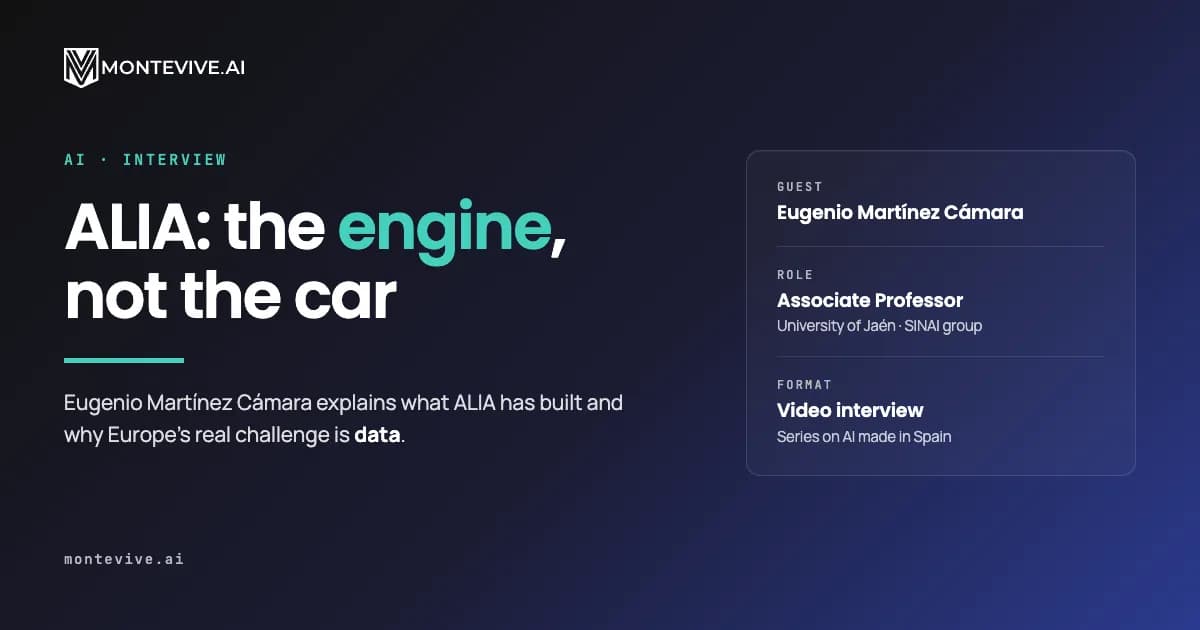
This interview opens a series of conversations on the Montevive AI channel about the AI technology being built in Spain. Our first guest was Eugenio Martínez Cámara, Associate Professor (profesor titular) at the University of Jaén, a member of the SINAI research group and vice-president of the Spanish Society for Natural Language Processing (SEPLN). He spent an hour with Chema and Rubén talking about ALIA, the public language-model project his group has worked on, and about what Europe has at stake with its data.
The interview is in Spanish. Everything below is what Eugenio told us and what he thinks, attributed to him. The facts we state as true carry their source at the end.
ALIA: the engine, not the car
ALIA is a public infrastructure of AI resources, with open and transparent language models for Spanish and Spain's other co-official languages. It is coordinated by the Barcelona Supercomputing Center (BSC), promoted by Spain's Secretary of State for Digitalisation and Artificial Intelligence, and publicly funded.
Eugenio started with the most common criticism: that ALIA doesn't work when you compare it with ChatGPT. His answer is an engineering one, not a defensive one. A commercial assistant is a foundation model plus all the scaffolding around it. ALIA, at its core, is the foundation model. Instruction-tuned versions exist, but as he explained, there is no version with full alignment training, because that was neither among the goals nor in the budget. If you evaluate it as a finished product, he said, the result can look terrible and "you have to admit they're right", but the goal was a different one.
His image was the car. According to Eugenio, if you announce a "Spanish ChatGPT" and present only the engine, people try to drive the engine as if it were a car, and the engine ends up discredited. He believes part of the criticism comes from there: expectations set too high and an announcement made before the work. In his reading, the 40-billion-parameter base model was released before the project began, for reasons that were more political than technical. That is his interpretation and we leave it as such.
On money and timelines he was just as direct. According to Eugenio, ALIA has cost less than 8 million euros (he warned that he didn't remember the exact figure), his team started work on 15 June 2025 and the project ended the day before the recording. Comparing it with ChatGPT, he said, is like comparing Real Jaén, a lower-league football club, with Real Madrid: each plays in its own league, and you have to know what was built, on what budget and in how much time.
What has been achieved
For Eugenio the result has three layers.
- Cooperation. As he told us, the project brought five research groups to work together, something unusual in a country that isn't used to investing in research.
- Results you can use. Models and data are published in AliaKit, for companies, public administrations and citizens.
- Technological sovereignty. His question is an uncomfortable one: would we put our healthcare or our defence in the hands of a model developed abroad, whether French or American?
He also stressed a point that rarely makes the headlines: every piece of data was requested from its owner. Eugenio led the data team in Jaén and assured us that nothing was used without asking and without signed agreements, in compliance with Spanish law and the European framework.
What the SINAI group contributed
The Jaén group focused on Spanish and on three domains: biomedical, cultural heritage and legal-administrative. In each one it built corpora and datasets to train foundation models, to instruction-tune them and to train discriminative models, plus one model per domain.
The example we liked best was the legal one. The corpus goes from the BOE, Spain's official state gazette, down to provincial and regional gazettes, and it includes public tenders so the model also learns that language. Eugenio described a test on administrative silence, the rule that decides what happens when the administration doesn't answer a request: according to him, Llama couldn't explain it and his version of ALIA could, telling apart the procedures where silence means yes from those where it means no. That is his example, not a published evaluation.
Cultural heritage was the hardest domain, because little information is available. The team had to contact heritage journals, explain the project to humanities researchers and negotiate with copyright collecting societies. Some said no, and others wanted to be "at the cutting edge of artificial intelligence".
Data and regulation: where Europe gets stuck
Here Eugenio was more critical. His thesis is that without data there is no competitive AI, and that Europe should rethink what kind of data protection it wants and what it wants for its AI ecosystem. He gave an example from his own experience: on a government project, one ministry asked them to use data while another denied them access to the catalogue records of the state museums, which in his view belong to the State and to every Spanish citizen.
On Regulation (EU) 2024/1689, the AI Act, he thinks it has a good foundation and a humanist culture behind it, but that it may be impossible to comply with if it demands legitimate data documentation and the rights holders say no. He suggested that other laws may need to be brought into line, and mentioned the debate in the European Parliament on a safeguard for the use of data in AI, adding that he believes he and a colleague signed a manifesto in support of it.
One piece of context that our question took for granted. The Digital Omnibus on AI postpones the obligations for the high-risk systems in Annex III to 2 December 2027, and those for systems embedded in products to 2 August 2028, according to KAN. The provisional agreement between the Council and the Parliament dates from 7 May 2026.
| Obligation | Previous date | Date after the Omnibus |
|---|---|---|
| High-risk systems in Annex III | 2 August 2026 | 2 December 2027 |
| High-risk systems embedded in products | 2 August 2027 | 2 August 2028 |
Our context, not Eugenio's testimony. New dates: KAN. Previous dates: Article 113 of the Regulation, in the consolidated version of the AI Act Explorer.
Eugenio also believes public tenders won't require ALIA by name ("that would kill the tender"), but they will require principles that today almost only ALIA meets: knowing what data it was trained on, being open and being auditable.
Privacy, security and robustness
One line of work Eugenio wants to pick up again is federated learning, the paradigm proposed by Google for training without moving the data. His example: processing the databases of five hospitals in five Spanish regions without centralising them, which removes the weakest link, the data transfer. On top of that you can add layers such as differential privacy, which adds noise to make it harder to recover the training data.
His reminder was that AI was not designed to be secure. There are attacks that reveal whether a person was in a training set, and his extreme case was someone with a rare disease applying for a mortgage. He also talked about robustness and attacks such as indirect prompt injection in RAG systems, and about the responsibility of teaching computer science students that a bug in an AI system can be like a miscalculated bridge.
Where all this comes from
We asked him whether there has been another breakthrough on the scale of "Attention Is All You Need" (2017). Eugenio replied that the origin goes much further back: to the idea, from mid-20th-century linguists, that the meaning of a word depends on its context. Embeddings come from there, then contextual embeddings and then transformers. His farming example was the word "stress", which doesn't mean the same thing for a field as for a person. He added that research today is almost impossible to keep up with: conferences can't find enough reviewers for the thousands of papers they receive.
How a company can use ALIA
His closing message is practical. If you can use ALIA on your own, go ahead: models and data are in AliaKit. If you need help adapting or integrating it, write to the SINAI group. According to Eugenio, his group has organised two ALIA forums, in Jaén and in Seville, and has built demonstrators with companies. His example was an olive oil mill in Jaén wondering what ALIA could do for it. The university, he said, is eager to work with companies, and companies need the university.
| If... | What to do | Where |
|---|---|---|
| You can use ALIA on your own | Download the models and data and try them | AliaKit |
| You need to adapt or integrate it | Write to the research group | SINAI group |
Our takeaways
- Don't compare an engine with a car. Before judging ALIA, look at its goal, budget and timeline, and at which part of the final product it covers.
- Data is the real constraint. Without legitimate and fast access to data, not even the best open European models can compete.
- Security doesn't come built in. Privacy, robustness and attacks on RAG are engineering work from day one.
- Universities and companies need each other. The models exist and are published: what's missing is people to take them into real use cases.
Sources
Everything this article states as fact comes from these sources. What we attribute to Eugenio is his testimony and opinion, and is not verified against them. If something doesn't add up, check it.
ALIA and its ecosystem
- ALIA, official site: project description, BSC coordination with the Secretary of State for Digitalisation and Artificial Intelligence, and public funding.
- ALIA Kit: documentation, models and data from the project.
- ALIA-40b on Hugging Face: the base model.
- datos.gob.es: ILENIA and the models for co-official languages (in Spanish), the earlier project Eugenio mentions.
The guest and his background
Regulation
- Regulation (EU) 2024/1689, the AI Act, on EUR-Lex.
- KAN, Digital Omnibus on AI: postponement dates of 2 December 2027 and 2 August 2028.
- JD Supra, EU legislators agree to delay for high-risk AI rules: provisional agreement of 7 May 2026.
- Future of Life Institute, AI Act Explorer, Article 113: previous application dates (2 August 2026 and 2 August 2027), in the consolidated text with amendments marked.
The technical side
- Vaswani et al., Attention Is All You Need, 2017.
- McMahan et al., Communication-Efficient Learning of Deep Networks from Decentralized Data, 2016, the federated learning paper.
Keep the conversation going
This is the first in a series. If there's a Spanish AI technology that deserves a conversation, or a question you'd have liked to ask Eugenio, tell us and we'll take it to the next interview. And if you have a use case for ALIA, the SINAI group and AliaKit are a good place to start.
Get the AI Radar every Monday
The AI news that matters to your company, picked and summed up in a short email (in Spanish). Unsubscribe whenever you like.