
Spain's AI guide for public administrations: what holds up and what's out of date
Lee este artículo en español.
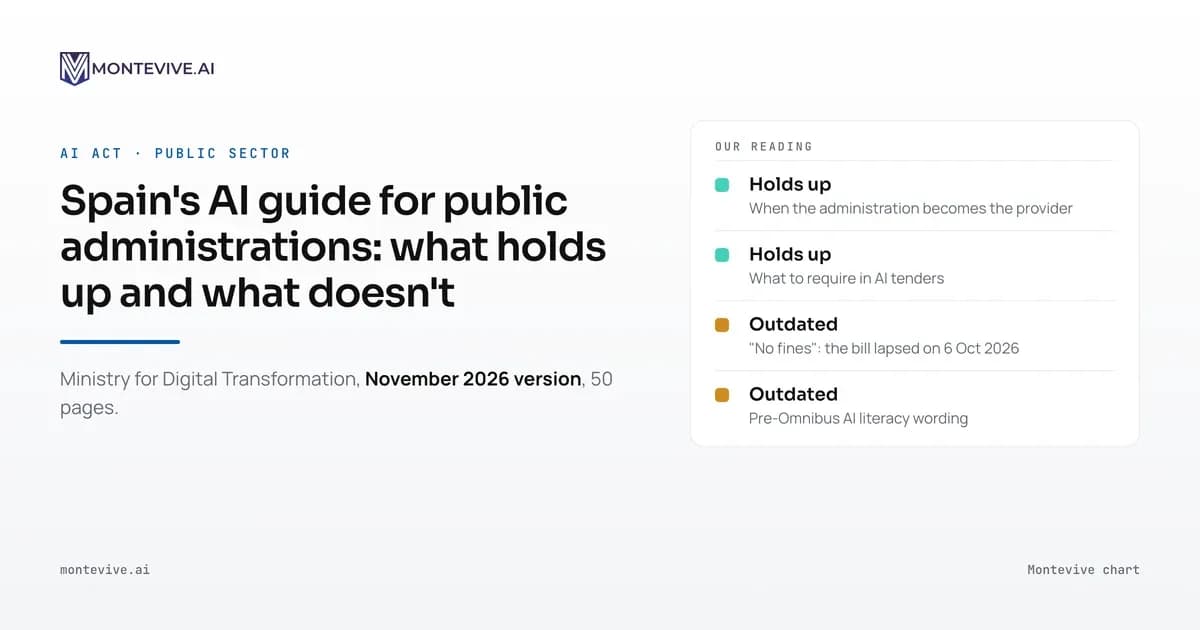
Spain's Ministry for Digital Transformation and the Civil Service has published a 50-page guide to help public administrations adopt artificial intelligence in line with the EU AI Act. To us, the most useful part is the one on procurement. It explains when a city council that commissions an AI system becomes, in law, its provider, and what it recommends requiring in tender documents.
There are two points where the guide is out of date. It states that administrations will not be fined, but takes that from a bill that lapsed in October. And it describes AI literacy using a version of Article 4 that the Digital Omnibus changed in July. If you plan to use it to buy or sell AI in the public sector, you need to know both.
What the guide is and who it's for
The "Guide for the ethical adoption of artificial intelligence in public administrations", in its November 2026 version, has four parts: a summary of the AI Act, how it applies to administrations, how to procure AI, and examples by risk level. It ends with an annex on general-purpose AI models.
It is written for people who drive, procure or oversee AI projects in ministries, regional governments, provincial councils and city councils. Companies that sell AI to the public sector can use it to see what public buyers are going to ask for.
It is not a regulation. It is guidance from the ministry, subject to "periodic updates", and it imposes nothing the AI Act doesn't already require.
The question that decides everything: provider or deployer?
The AI Act assigns obligations by role. The provider puts the system into service under its own name and carries the conformity assessment, technical documentation, quality management system and CE marking. The deployer uses it: monitors it, keeps the logs and ensures human oversight.
Whether an administration is one or the other doesn't depend on whether it paid a company, but on how it buys and uses each system.
Montevive diagram, based on sections 2.1.4 and 3.1 of the guide.
The guide sums it up in four scenarios:
- It buys an off-the-shelf product and uses it as intended. It is the deployer. It must check that the system carries the CE marking and meet its obligations as a user.
- It commissions a custom system and puts it into service under its own name. It is the provider, even if a company wrote the code. According to the guide, a provider cannot "free itself from its responsibilities" by passing them on to a subcontractor.
- It builds the system with its own staff. It is also the provider.
- It buys a product but uses it for another purpose or modifies it substantially. It becomes the provider of a new system. That is the rule in Article 25 of the AI Act.
The last case can happen without anyone formally deciding it. The guide gives an example: a city council buys a system that recommends how to handle non-urgent incidents and, over time, uses it to decide how to allocate social assistance.
That use is high-risk (Annex III, point 5(a)). It turns the council into the provider and forces it to gather documentation it doesn't have, because it didn't build the system.
For a company bidding for public contracts, this means that if the contract is for a custom build, your client will be the legal provider. It will need from you everything the AI Act requires it to prove, and the sensible thing is for the contract to say so before work starts.
What administrations will ask for in tenders
Before getting to tender documents, the guide asks whether AI is needed at all. It compares two cases. Sorting incoming correspondence and routing it to the right department is a good use, because it works with unstructured text. Applying a seniority bonus in payroll is not: those are fixed rules, and plain automation will do.
It then sets out nine recommendations for procuring AI. These are the ones that matter most to sellers:
- CE marking and documentation. When buying a product, the administration must make sure the system has it. Without it, it would be using a non-compliant system.
- Roles in writing. For a custom build, the guide recommends that the contract set out each party's role, the risk level, which high-risk obligations each party meets, how conformity is assessed and who owns the intellectual property.
- EU model contractual clauses. It points to those published by the European Commission's community of public buyers: one version for high-risk systems (MCC-AI High-Risk) and a "light" one for the rest (MCC-AI Light).
- Cost control. The tender should require the system to measure its costs and consumption, keep a trail of who uses it and alert when spending spikes. It is the cost side of AI observability.
- Interoperability and knowledge transfer. The supplier must integrate the tool with the body's systems, hand over manuals and train the staff who will inherit it.
The guide also recommends describing the problem and the expected performance in the tender, and letting bidders propose the technical solution.
Three examples from the guide worth knowing
A chatbot for administrative procedures has transparency obligations. The guide asks for a notice at the start of the conversation, a note on every generated answer and a disclaimer that it doesn't provide legal advice. We cover this in detail in Article 50 of the AI Act.
An assistant that helps a procurement board review bids and spot formal inconsistencies is minimal-risk according to the guide, because it doesn't make the final decision. For the guide, its only legal obligation is AI literacy for the staff who use it. If the system started scoring bids without anyone reviewing the scores, that classification would have to be redone.
A system that prioritises emergency calls is high-risk (Annex III, point 5(d)), even if the administration buys it ready-made. The administration must check that it carries the CE marking, assign someone with authority to oversee it, monitor how it works and agree with the provider what to do if it fails.
The timeline for a public administration
- Since 2 February 2025: prohibited practices and AI literacy.
- Since 2 August 2026: transparency for chatbots and generated content (Article 50).
- 2 December 2027: Annex III high-risk systems, such as those for social benefits, public employment, education or emergencies.
- 2 August 2028: Annex I high-risk systems, AI inside regulated products.
- 2 August 2030: deadline to bring high-risk systems already in service at public authorities into line (Article 111(2)).
Where the guide lags behind the law
| What the guide says | What the law says today |
|---|---|
| Under the draft Organic Law on AI, administrations "will not be financially penalised". | The bill lapsed on 6 October 2026, when Parliament was dissolved. Whether an administration can be fined is undecided. |
| Administrations "must ensure" their staff have "adequate knowledge" (Article 4). | Since the Omnibus, Article 4 asks for measures to support AI literacy and says it does not require ensuring "a specific level" for any person. |
On fines, the guide calls the bill a "proposal", but doesn't mention that it lapsed six weeks before the guide came out. The AI Act lets each Member State decide whether to fine its public authorities (Article 99(8)), and in Spain that will be up to the Parliament elected on 29 November. We cover it in AI Act in Spain: the national bill has lapsed.
The same bill split supervision: the Spanish AI Supervisory Agency (AESIA) for most cases, the data protection authority (AEPD) for biometrics and the General Council of the Judiciary for justice, among others. The guide presents this as a proposal, and it is also pending.
On AI literacy, Regulation (EU) 2026/1744, the Omnibus, rewrote Article 4. The obligation remains, but it now means taking measures tailored to each role and its context of use. A city council will need to plan training by job and keep a record of what it did, rather than trying to certify one level for all staff.
A technical caveat on in-house servers
The guide says on-premise infrastructure gives the most control over data but has "significant limitations" for generative AI. For the largest models, that's true. For narrow tasks, such as sorting incoming correspondence, which the guide itself uses as an example, there are now open models that run on an in-house server. We measured this for text classification in Jev vs BERT.
What the guide doesn't solve
The guide doesn't solve the practical problem of a small administration: having someone who understands the technology well enough to draft the tender, assess the bids and oversee the contract. It acknowledges this and calls for multidisciplinary teams, but doesn't say how to train or find them.
What to do now
If you work in a public administration:
- Take inventory of the AI systems you already use, including those that arrived as one more feature of another product.
- Decide the role before the tender. Off-the-shelf product or custom build: that determines whether you are the provider.
- Use the MCC-AI clauses as a starting point, the high-risk or light version as appropriate.
- If the system is high-risk, assess its impact on fundamental rights (Article 27) and register it in the EU database (Article 49(3)).
If you sell AI to the public sector:
- State in your bid who will be the legal provider and what documentation you will hand over.
- Prepare the package: instructions for use, technical documentation, activity logs and cost control with alerts.
- Write in the instructions what your product must not be used for. That lets your client know whether a new use makes it the provider.
If your council or your company had to show tomorrow what role it plays in each AI system it uses, could it? In an AI Act assessment we take that inventory, classify each use by risk and tell you what falls to you as provider and what as deployer.
Sources
- Spanish Ministry for Digital Transformation and the Civil Service, Guide for the ethical adoption of artificial intelligence in public administrations (in Spanish), November 2026 version (NIPO 230260102), CC BY 4.0 licence.
- Regulation (EU) 2024/1689 (AI Act): Articles 4, 25, 27, 49, 50, 99, 111 and Annex III.
- Regulation (EU) 2026/1744 (Digital Omnibus on AI) (Spanish Official State Gazette copy), OJ of 24 July 2026.
- Spanish Congress of Deputies, file 121/000096 (in Spanish), draft Organic Law on the proper use and governance of artificial intelligence: "Concluded (Lapsed)" since 6 October 2026.
- European Commission community of public buyers, model contractual clauses for AI procurement (MCC-AI), February 2025 version.
This article reflects the regulatory framework as of 20 November 2026. It is for information only and is not legal advice.
Get the AI Radar every Monday
The AI news that matters to your company, picked and summed up in a short email (in Spanish). Unsubscribe whenever you like.